
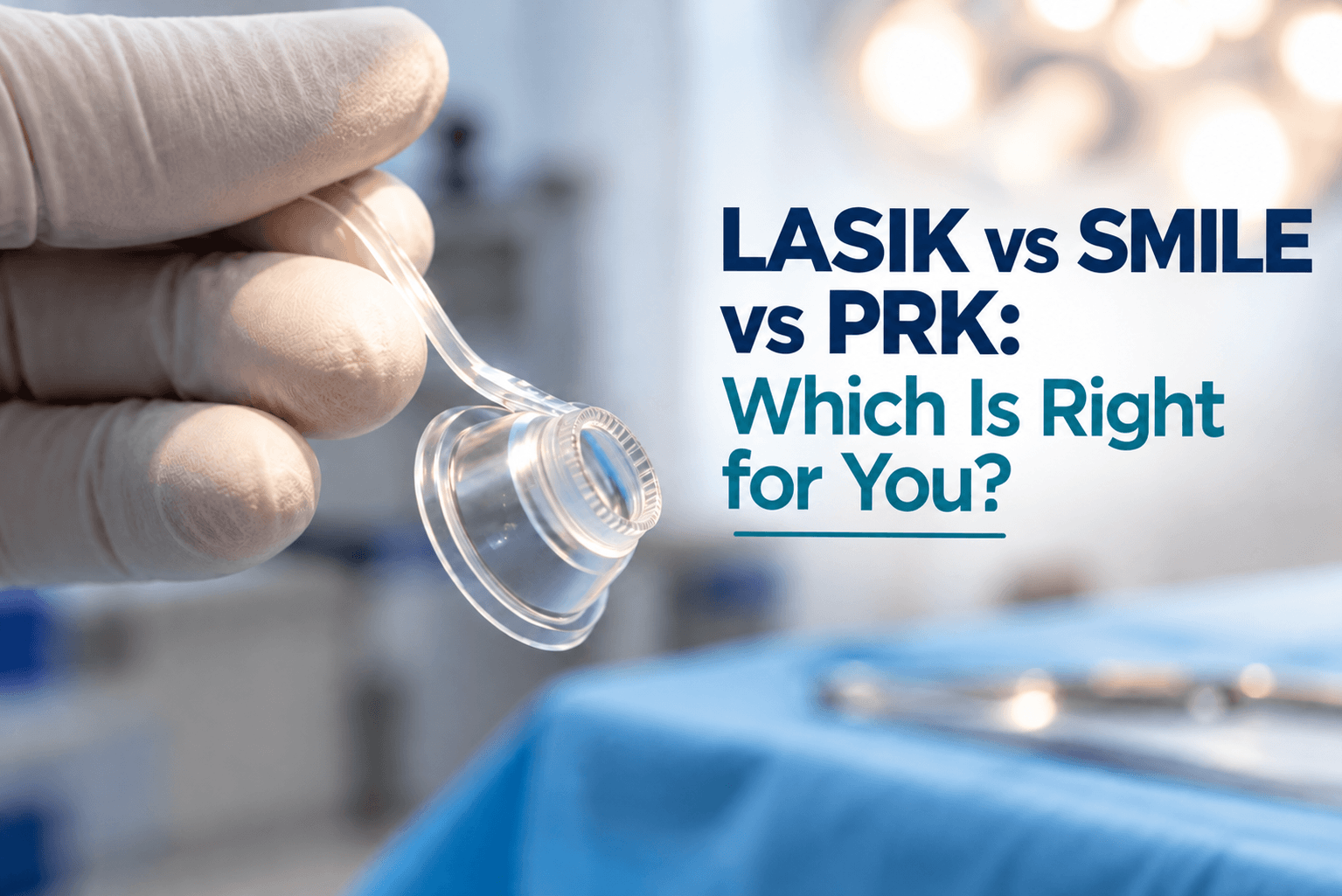
Wearing glasses or contact lenses can become part of everyday life, but many people eventually consider a more permanent way to reduce their dependence on them. With advances in modern ophthalmology, several types of laser vision correction are available today. Among the most widely discussed options are LASIK, SMILE, and PRK.
But when comparing LASIK vs SMILE vs PRK, which procedure is right for you?
The answer is not the same for everyone. Each procedure uses a different technique to reshape or modify the cornea, and factors such as your eye health, corneal thickness, prescription, lifestyle, dry-eye symptoms, and visual goals can influence which treatment may be appropriate.
This guide explains the key differences between LASIK, SMILE, and PRK so you can have a more informed discussion with an eye specialist.
What Is Vision Correction Surgery?
Vision correction surgery refers to procedures designed to reduce refractive errors such as myopia, hyperopia, and astigmatism. These procedures change the way light is focused on the retina, potentially reducing dependence on glasses or contact lenses.
LASIK and PRK use an excimer laser to reshape the cornea, while SMILE eye surgery uses a femtosecond laser to create and remove a small piece of corneal tissue called a lenticule.
Although all three procedures aim to improve vision, the surgical approach and recovery process are different.
LASIK Eye Surgery: Fast Visual Recovery
LASIK eye surgery is one of the most established forms of laser eye surgery. During LASIK, a thin corneal flap is created. The underlying corneal tissue is then reshaped using an excimer laser, after which the flap is repositioned.
One of the major attractions of LASIK is its relatively quick visual recovery compared with surface-based procedures such as PRK.
Potential advantages of LASIK
- Rapid improvement in vision for many suitable patients
- Well-established procedure with extensive clinical experience
- Can correct several common refractive errors
- Minimal discomfort is generally reported during the procedure
- Customized treatment options may be available depending on the patient’s eye measurements
However, LASIK is not suitable for every eye. Corneal thickness, corneal shape, dry-eye symptoms, prescription, and overall eye health must be evaluated before treatment.
Because LASIK involves creating a corneal flap, flap-related considerations are also part of the preoperative assessment.
SMILE Eye Surgery: A Small-Incision Approach
SMILE eye surgery, or Small Incision Lenticule Extraction, is a newer form of laser vision correction. Instead of creating a large corneal flap, a femtosecond laser creates a small lenticule inside the cornea. The surgeon then removes this lenticule through a small incision.
The procedure is particularly established for the treatment of myopia and myopic astigmatism.
Potential advantages of SMILE
- No conventional LASIK flap
- Small corneal incision
- Less disruption to some corneal nerves compared with LASIK
- May have advantages regarding postoperative ocular surface symptoms in some patients
- Can be an option for people whose lifestyle makes flap-free surgery appealing
Clinical comparisons have found broadly similar visual and refractive outcomes between SMILE and modern LASIK in appropriately selected patients, although the procedures differ in technique and recovery characteristics.
SMILE is not automatically better than LASIK. The right procedure depends on individual eye measurements and the type of refractive error being treated.
PRK Eye Surgery: A Surface-Based Option
PRK eye surgery, or Photorefractive Keratectomy, is another established form of laser vision correction. Unlike LASIK, PRK does not create a corneal flap.
Instead, the surface epithelial layer of the cornea is removed to allow the excimer laser to reshape the underlying corneal tissue. The surface then heals naturally.
Potential advantages of PRK
- No corneal flap
- Can be considered when corneal thickness or shape makes LASIK less suitable
- Useful in selected patients where avoiding a flap is important
- Long history of clinical use and research
The trade-off is recovery. PRK generally involves more postoperative discomfort and slower visual recovery than LASIK. Vision can continue to improve over several weeks, with stabilization taking longer in some patients.
For certain patients, however, the slower recovery can be an acceptable trade-off.
LASIK vs SMILE vs PRK: Key Differences
Understanding the differences between LASIK, SMILE, and PRK can make your consultation easier.
Feature | LASIK | SMILE | PRK |
Surgical approach | Corneal flap + laser reshaping | Small incision + lenticule removal | Surface treatment + laser reshaping |
Flap created? | Yes | No | No |
Visual recovery | Generally fast | Generally fast | Slower |
Surface healing required | No major surface healing phase | No major surface healing phase | Yes |
Postoperative discomfort | Usually limited | Usually limited | Generally greater initially |
Common application | Myopia, hyperopia, astigmatism depending on treatment | Primarily myopia and myopic astigmatism | Myopia and other refractive errors in selected cases |
Suitable for everyone? | No | No | No |
This comparison shows why there is no universal winner in LASIK vs SMILE vs PRK. Each technique has its own strengths, limitations, and patient-selection criteria.
LASIK vs PRK: Which Factors Matter?
The LASIK vs PRK decision often comes down to corneal characteristics and lifestyle.
LASIK may be attractive when rapid visual recovery is a priority and the cornea is suitable for flap-based surgery.
PRK may be considered when avoiding a corneal flap is important or when certain corneal characteristics make surface ablation more appropriate.
For example, PRK may be considered in some patients with relatively thin corneas or anatomical features that make creating a LASIK flap less desirable. However, only a detailed examination can determine whether this applies to an individual patient.
LASIK vs SMILE: How Are They Different?
When comparing LASIK vs SMILE, the biggest difference is the surgical technique.
LASIK reshapes the cornea after creating a flap, while SMILE removes a small lenticule through a small incision without creating a conventional flap.
Studies comparing the two procedures have found comparable visual outcomes in appropriately selected patients. SMILE may have an advantage in preserving certain corneal nerves and may produce fewer ocular-surface effects for some patients, although individual experiences vary.
The choice should therefore be based on your prescription, corneal measurements, eye-surface health, lifestyle, and the surgeon’s assessment rather than simply choosing the newer procedure.
SMILE vs PRK: What Should You Know?
The SMILE vs PRK comparison is also about more than recovery time.
Both procedures avoid the conventional LASIK flap, but they use different approaches. SMILE removes an intrastromal lenticule through a small incision, whereas PRK reshapes the cornea from the surface after removing the epithelial layer.
PRK typically requires a longer healing period because the corneal surface needs to regenerate. SMILE generally offers a quicker recovery for suitable patients.
However, PRK remains an important option for selected patients who may not be candidates for LASIK or SMILE.
What Happens Before Laser Eye Surgery?
A comprehensive eye examination is one of the most important parts of the process.
Before recommending laser eye surgery, an eye specialist may evaluate:
- Your current glasses or contact lens prescription
- Corneal thickness
- Corneal curvature and topography
- Tear-film and dry-eye status
- Pupil size
- Overall eye health
- Stability of your prescription
- Presence of conditions that could increase surgical risk
These assessments help determine whether laser vision correction is appropriate and, if so, which procedure may be most suitable.
It is important to remember that having a desire to stop wearing glasses does not automatically make someone a candidate for refractive surgery.
Which Vision Correction Surgery Is Right for You?
There is no single procedure that is ideal for every patient.
LASIK may appeal to suitable candidates who prioritize rapid visual recovery and have corneal characteristics appropriate for flap-based treatment.
SMILE may be an option for eligible patients who want a flap-free procedure and are suitable for lenticule extraction.
PRK may be considered when a surface-based procedure is more appropriate, particularly in selected patients where avoiding a LASIK flap is an important consideration.
The most appropriate choice should be made after a detailed examination rather than based solely on online comparisons, advertisements, or another person’s experience.
Why Choose Desai Eye Institute for Advanced Eye Care in Vadodara?
Choosing the right procedure is only one part of successful vision correction. A detailed evaluation, appropriate patient selection, advanced diagnostic assessment, and experienced ophthalmic care are equally important.
At Desai Eye Institute, patients can discuss their vision correction goals with an experienced eye-care team and undergo the necessary evaluation to understand their available options.
If you are considering LASIK, SMILE, PRK, or another form of refractive treatment, a personalized consultation can help you understand the potential benefits, limitations, recovery expectations, and risks associated with each option.
For patients looking for Advanced Eye Care in Vadodara, choosing an eye-care centre that emphasizes thorough evaluation and individualized treatment planning can make the decision-making process clearer.
If you are searching for the Best Eye Doctor in Vadodara or a Top Eye Specialist in Vadodara for guidance regarding laser vision correction, Desai Eye Institute can help you take the next step toward understanding your options.
Final Thoughts
The choice between LASIK vs SMILE vs PRK is not simply about which procedure is newest or fastest. It is about finding an approach that matches your eyes, prescription, lifestyle, expectations, and overall ocular health.
LASIK, SMILE, and PRK can all provide effective vision correction for appropriately selected patients, but they differ in surgical technique, recovery, and patient suitability.
A comprehensive eye examination with a qualified ophthalmologist is the best way to determine whether you are a candidate for laser vision correction and which procedure may be appropriate for you.
Better vision begins with the right evaluation. Make an informed decision with personalized guidance from an experienced eye-care team.