

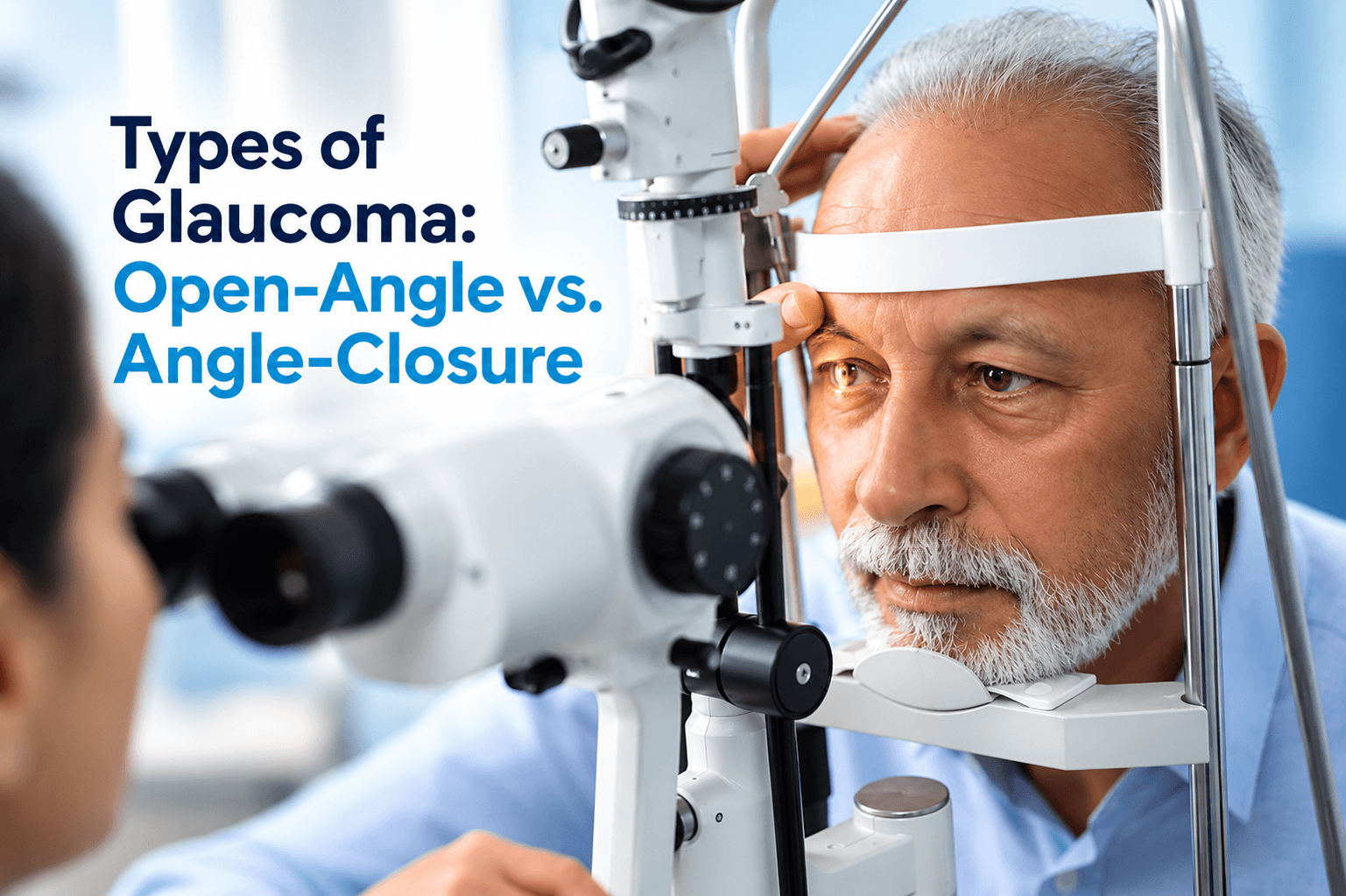
Glaucoma is often called a “silent” eye disease because it can damage the optic nerve gradually without noticeable symptoms in its early stages. If left untreated, glaucoma can lead to permanent vision loss. Understanding the types of glaucoma, their symptoms, causes, and treatment options can help you recognise why regular eye examinations are so important.
Among the different glaucoma types, open-angle glaucoma and angle-closure glaucoma are two important forms that differ in how fluid drains from the eye and how the condition may develop. Knowing the difference between open-angle vs. angle-closure glaucoma can help you understand what your eye specialist may look for during an examination.
What Is Glaucoma?
Glaucoma is a group of eye diseases that damage the optic nerve, which carries visual information from the eye to the brain. Increased pressure inside the eye is an important risk factor, although glaucoma can also occur when eye pressure is within what is considered a normal range.
The eye continuously produces a clear fluid called aqueous humour. This fluid normally circulates through the front of the eye and drains through a structure called the trabecular meshwork. When drainage becomes impaired, fluid can build up and increase pressure inside the eye. Over time, this may damage the optic nerve.
One of the challenges with glaucoma is that early damage may not be obvious. Vision loss often begins with peripheral or side vision, and a person may not notice the change until the disease has progressed.
What Are the Main Types of Glaucoma?
There are several types of glaucoma, including primary and secondary forms. Some develop without another identifiable eye condition, while others may occur because of another medical condition, medication, injury, inflammation, or changes within the eye.
Some recognised glaucoma types include:
- Open-angle glaucoma
- Angle-closure glaucoma
- Normal-tension glaucoma
- Congenital glaucoma
- Neovascular glaucoma
- Pigmentary glaucoma
- Exfoliation glaucoma
- Uveitic glaucoma
Among these, open-angle and angle-closure glaucoma are particularly important because they involve different problems with the eye’s drainage angle.
Open-Angle Glaucoma: The Gradual Form
Open-angle glaucoma is the most common form of glaucoma. In this condition, the drainage angle remains physically open, but fluid does not drain through the trabecular meshwork efficiently enough.
As drainage becomes less effective, pressure inside the eye may increase and gradually damage the optic nerve. However, not everyone with glaucoma has high eye pressure. Some people develop optic nerve damage even when their pressure falls within a typical range.
What Are the Symptoms of Open-Angle Glaucoma?
One of the biggest concerns with open-angle glaucoma is that it may have few or no noticeable symptoms during its early stages.
As the condition progresses, a person may experience:
- Gradual loss of peripheral vision
- Difficulty noticing objects to the side
- Blind spots in the visual field
- Increasing difficulty with vision as the disease advances
Because these changes can happen slowly, routine eye examinations are important even when your vision appears normal.
Angle-Closure Glaucoma: When Drainage Becomes Blocked
Angle-closure glaucoma occurs when the iris blocks or significantly narrows the drainage angle through which fluid leaves the eye. This can cause eye pressure to rise rapidly, particularly during an acute attack.
Unlike the gradual nature commonly associated with open-angle glaucoma, acute angle-closure glaucoma can produce sudden and severe symptoms.
Angle-Closure Glaucoma Symptoms
Symptoms of an acute attack can include:
- Severe eye pain
- Redness in the eye
- Sudden blurred vision
- Headache
- Nausea or vomiting
- Seeing coloured rings or halos around lights
Acute angle-closure glaucoma is a medical emergency. Sudden symptoms such as severe eye pain, redness, blurred vision, and nausea require immediate medical attention because untreated acute angle closure can cause rapid and serious vision loss.
Chronic or slower forms of angle closure can develop differently and may not produce dramatic symptoms at first. This makes eye examinations particularly important for people who may have narrow drainage angles.
Open-Angle vs Angle-Closure Glaucoma: What Is the Difference?
The simplest way to understand open-angle vs angle-closure glaucoma is to look at what happens to the drainage angle.
Feature | Open-Angle Glaucoma | Angle-Closure Glaucoma |
Drainage angle | Remains open | Becomes narrowed or blocked |
Onset | Usually gradual | Can be sudden or gradual |
Early symptoms | Often absent | Acute attacks may cause obvious symptoms |
Eye pressure | May be elevated or normal | Can rise rapidly during acute attacks |
Vision loss | Usually gradual | Can become rapid during an acute attack |
Urgency | Requires ongoing evaluation and management | Acute attacks require immediate medical attention |
Although the two conditions are different, both can damage the optic nerve and threaten vision if they are not properly diagnosed and managed.
What Causes Glaucoma?
The exact causes of glaucoma vary depending on the type. In many cases, doctors cannot identify one single cause. Elevated eye pressure is an important risk factor, but it does not automatically mean that someone will develop glaucoma.
Risk can also be influenced by factors such as age, family history, certain medical conditions, eye anatomy, previous eye injuries, inflammation, and some medications. Certain forms of glaucoma can develop secondary to conditions such as diabetes, uveitis, or previous eye trauma.
Importantly, glaucoma can affect people who do not notice any changes in their vision. That is why relying only on symptoms is not enough.
How Is Glaucoma Diagnosed?
A comprehensive eye examination helps an ophthalmologist assess whether glaucoma is present and determine the extent of any optic nerve damage.
Depending on the individual, an evaluation may include:
- Measurement of intraocular pressure
- Examination of the optic nerve
- Visual field testing
- Dilated eye examination
- Assessment of the drainage angle
- Imaging of the optic nerve and retinal structures
Advanced diagnostic imaging can also provide detailed information about the eye. For example, Desai Eye Institute offers anterior segment optical coherence tomography, which can help assess the drainage angles and support the evaluation of glaucoma and other eye conditions.
Can Glaucoma Be Treated?
While glaucoma-related optic nerve damage cannot simply be reversed, treatment can help lower eye pressure and reduce the risk of further damage.
Depending on the type and severity of glaucoma, treatment may include:
- Prescription eye drops
- Laser treatment
- Surgical procedures
- Regular monitoring and follow-up
The appropriate treatment depends on the patient’s diagnosis, eye pressure, optic nerve condition, visual field, overall eye health, and other individual factors.
For some patients with open-angle glaucoma, laser procedures may be considered. Surgery may also be recommended when medicines or laser treatment are not sufficient to control the condition.
When Should You See an Eye Specialist?
Do not wait for noticeable vision loss before having your eyes checked. Glaucoma can progress without obvious early symptoms, making regular comprehensive eye examinations an important part of protecting long-term vision.
If you suddenly develop severe eye pain, redness, blurred vision, headache, nausea, or vomiting, seek urgent medical attention because these symptoms can occur with acute angle-closure glaucoma.
Advanced Eye Care for Glaucoma in Vadodara
Choosing the right eye care centre can make regular monitoring and long-term glaucoma management easier. Desai Eye Institute & Eye Hospitals in Vadodara provides glaucoma evaluation and management along with a broad range of ophthalmic services. Its glaucoma service includes diagnostic evaluation, personalised treatment planning, medical and surgical options, and regular follow-up.
The institute describes its approach as combining advanced technology, evidence-based care, and personalised treatment. It also provides comprehensive ophthalmic services, including glaucoma management.
If you are looking for Advanced Eye Care in Vadodara, need an evaluation from a Best Eye Doctor in Vadodara, or want to consult a Top Eye Specialist in Vadodara, a comprehensive eye examination can help identify glaucoma early and guide appropriate care.
Protect Your Vision With Regular Eye Care
Understanding the types of glaucoma is an important first step, but early detection remains one of the most valuable ways to protect your vision. Open-angle glaucoma can progress quietly, while angle-closure glaucoma can sometimes become an urgent medical condition. Regular examinations allow an eye specialist to assess eye pressure, the optic nerve, visual field, and other important structures before significant vision loss occurs.
At Desai Eye Institute, patients can access specialised glaucoma care supported by advanced diagnostic technology and personalised treatment planning. If you have glaucoma symptoms, a family history of glaucoma, or concerns about your eye health, schedule a comprehensive eye examination and discuss your risk with an ophthalmologist.
Your vision deserves attention before a problem becomes noticeable.